
How laws are made
Laws that apply in the UK are not all made in one way. Parliament passes Acts, ministers and other bodies can make delegated legislation under powers given by an Act, and Scotland, Wales and Northern Ireland have their own law-making institutions. This area explains the different routes and where the important exceptions fit.
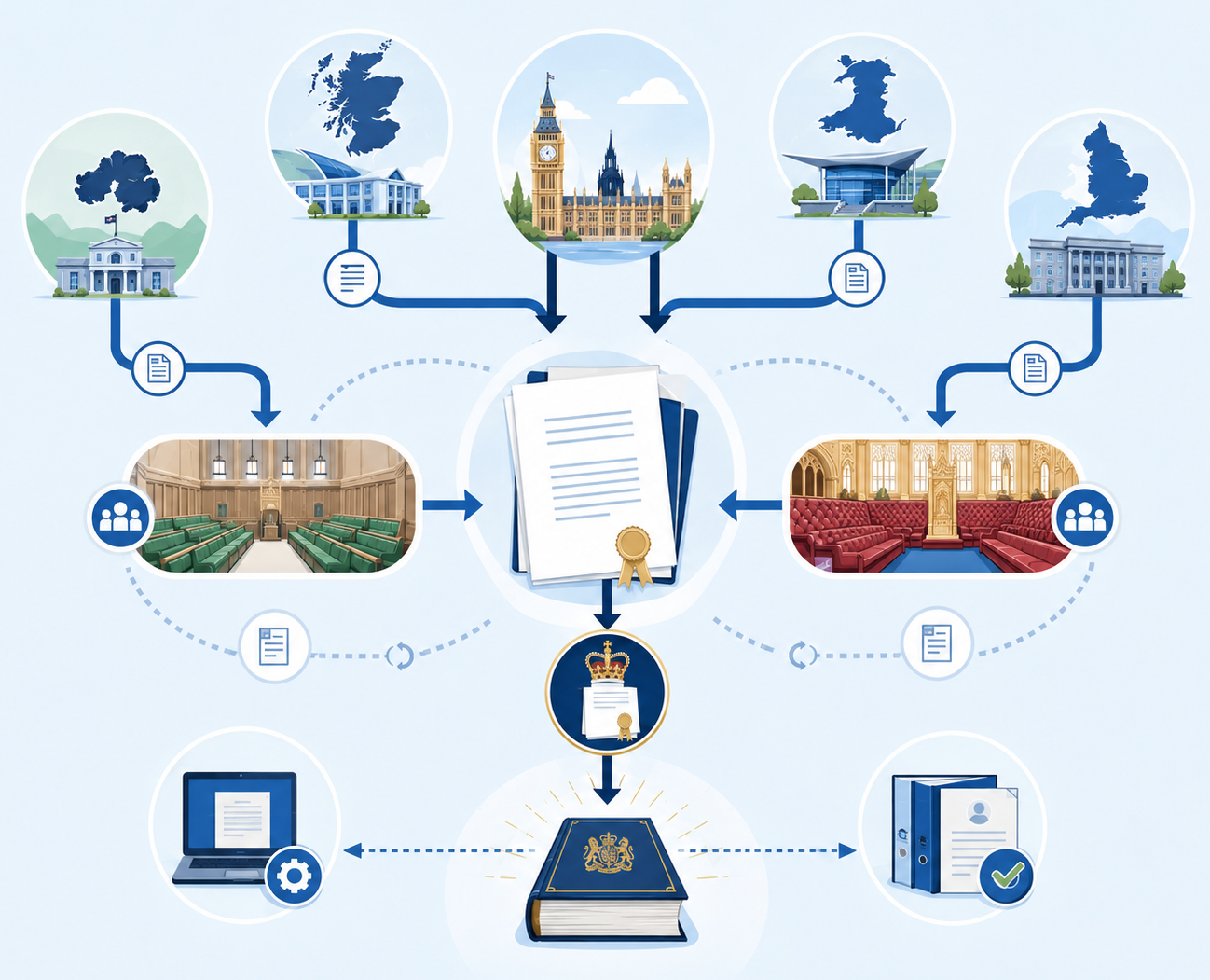
There is no single route into law
A Westminster Bill is one important route, but it is not the whole picture. The pages in this area separate the different processes so that a reader can understand the route that matters without having to learn the entire constitutional system first.
Four useful routes to understand
Choose the route that best matches what you are trying to follow.
An Act of the UK Parliament
A Bill is introduced, debated, examined and may be amended. Usually both Houses must agree the same text before Royal Assent.
Interactive timeline live Follow a Bill →Delegated legislation
An Act can give a minister or another body power to make more detailed law later, often through a statutory instrument.
Detailed guide plannedLaw made by devolved legislatures
The Scottish Parliament, Senedd and Northern Ireland Assembly can make laws within their legislative competence. Their procedures are not identical to Westminster’s.
Devolution guides plannedOther sources of law
Courts develop case law, while existing EU-derived arrangements and international obligations can also affect the law. These do not all follow the parliamentary Bill route.
Source guides plannedThree distinctions that prevent common confusion
Bill ≠ Act ≠ fully in force
A Bill is a proposal. After Royal Assent it becomes an Act, but some provisions may begin later rather than taking effect immediately.
Made at Westminster ≠ necessarily UK-wide
Legislation can extend or apply differently across England, Wales, Scotland and Northern Ireland. The territorial position has to be checked.
Making a law ≠ implementing it
Parliament may create the legal framework, while ministers, departments or public bodies can be responsible for detailed rules or putting the law into practice.
Interactive tools for this learning area
The tools will answer a specific question first, then link into the fuller guide when more explanation is useful.
How a Bill becomes law
Move through the ordinary Westminster Bill journey stage by stage, choose the starting House and see what happens at each point.
Open timeline →Who can make laws on this?
Choose a policy area and part of the UK to understand which legislature generally has responsibility — with warnings where the answer is more complicated.
Has this become law yet?
Distinguish a proposal from a Bill, an Act and provisions that have actually come into force.
How the detailed guides will fit together
Each subject will have one main guide that owns the full explanation. Other pages will give only the context they need and link back to it.
Acts of the UK Parliament
The ordinary Bill journey, plus the important cases where the usual route changes.
-
How a Bill becomes lawPublished
The Westminster journey from introduction to Royal Assent and commencement, with an interactive timeline.
-
Different types of BillsPlanned
Government and Private Members’ Bills, plus public, private, hybrid and special categories.
-
When the Commons and Lords disagreePlanned
Ping-pong, Money Bills, financial privilege and the Parliament Acts.
-
When does an Act actually take effect?Planned
Royal Assent, commencement, commencement orders and the difference between becoming an Act and being in force.
Delegated legislation
How Parliament can give ministers or other bodies power to make detailed law under an Act.
-
How delegated legislation worksPlanned
Parent Acts, statutory instruments and the main scrutiny procedures.
-
Henry VIII powers and skeleton BillsPlanned
When delegated powers can alter primary legislation and why the breadth of those powers matters.
Law-making across the UK
Scotland, Wales and Northern Ireland have their own legislatures and their own procedures.
-
Who can make laws on this?Planned interactive
A future selector for understanding legislative competence across the four parts of the UK.
-
How laws are made in ScotlandPlanned
The Scottish Parliament’s own Bill stages and legislative competence.
-
How laws are made in WalesPlanned
How Senedd Bills are considered and become Acts of Senedd Cymru.
-
How laws are made in Northern IrelandPlanned
The Assembly’s legislative stages and the Northern Ireland competence framework.
-
When Westminster legislates on devolved mattersPlanned
Legislative consent, the Sewel convention and why legal power and political convention are not the same thing.
What law applies — and where it comes from
Not every rule affecting the UK begins as a Westminster Bill, and not every Act applies in the same way everywhere.
-
Where does a law apply?Planned
Extent, territorial application and commencement across England, Wales, Scotland and Northern Ireland.
-
Where does UK law come from?Planned
Primary legislation, delegated legislation, case law and other sources of law.
-
What does EU law mean in the UK now?Planned
Assimilated law, the Withdrawal Agreement and the distinct position of Northern Ireland.
Related guides you can use now
These guides focus on interpreting parliamentary votes rather than teaching the whole law-making process, so they will remain separate and link into this area where useful.
Follow the process, then see the live record
The learning pages explain the procedure. Project Open Gov’s trackers show the Bills and votes moving through Parliament.
Official sources
Use these official sources to follow Bills, legislation and the different law-making institutions across the UK.